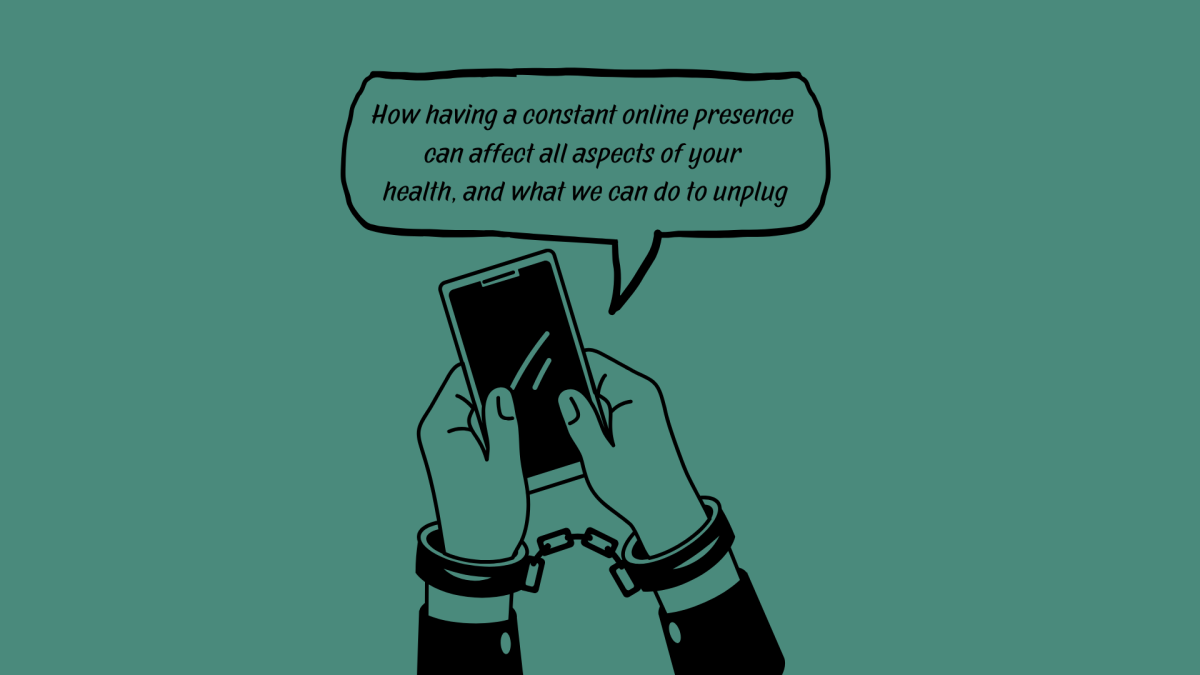
Let’s be honest for a second, most of us probably don’t want to share our screen time. I’ll be the first to admit that all the games, messages, and headlines draw me in and keep my attention for way too long. This is exactly what social media platforms, online shopping apps, or even video games are designed to do. They want to get you online and keep you there, but that’s not healthy. With summer break approaching quickly, it’s time to think about the negative effects of doomscrolling and what activities you can do instead.
Physical Effects:
A lot of the negative physical effects from being “chronically online” stem from cortisol. Encyclopedia Britannica explains cortisol as, “an asteroid hormone produced and secreted by the adrenal glands. Cortisol serves a critical role in various physiological processes, including stress responses, immune function, and metabolic regulation. It is a potent anti-inflammatory agent…” Cortisol is good in normal levels and beneficial for all kinds of bodily regulations; however, in constant high levels, it is more of a hurt than a help.
Therapy Group of DC tells us that “Researchers have linked high daily screen time with elevated cortisol.” Now that we understand what cortisol is and that high screen time raises cortisol to an unhealthy level, it leaves one question: What are the negative effects of excessive cortisol? While there are many, Healthline gives us some main examples: “severe fatigue, difficulty concentrating, high blood pressure, and headaches.” While none of this is a direct diagnosis, with these symptoms, it’s best to play it safe and stop the screens.
What can you do instead of doomscrolling that might ALSO lower your cortisol?
Healthline shares a couple of potential cortisol-lowering activities: “Regular exercise can help reduce your risk of chronic disease, reduce stress, and improve overall health, according to the National Institute of Diabetes and Digestive and Kidney Disease (NIDDK). This can help lower cortisol over time.” Exercise in non-intensive sessions can lower your cortisol levels built up from doomscrolling online.
Healthline shares another summer activity that could lower cortisol: “Laughing promotes the release of endorphins and suppresses stress hormones such as cortisol. It’s also linked with better mood, reduced stress and perceived pain, lower blood pressure, and a stronger immune system.” To put it plainly, spending time with friends and loved ones this summer gets you laughing and unplugged, which in turn can lower your cortisol and improve your mood.
One last avenue of lowering cortisol levels is spending time with animals. Whether you have pets or not, there are many volunteering opportunities, especially during your summer free time, to lower your cortisol and give back to your community at the same time. Healthline supports this in saying, “Relationships with animal companions can also reduce cortisol.”
A second concern of doomscrolling for our physical health is our circadian rhythm and how late-night finds turn into rough early mornings. The Cleveland Clinic best describes our circadian rhythm as, “your body’s natural 24-hour clock. It keeps your body operating on a healthy wake-sleep cycle.” Since our circadian rhythm is like our 24-hour internal clock, one of the signs that it’s time to go to bed is when our melatonin rises.
Blue light from our screens signals there should be a delay in that melatonin production, which in turn doesn’t make us sleepy, making it hard to go to bed. So let’s stop those late-night finds, because inevitably our alarm clocks are going to wake us up way sooner than we’d like, resulting in those rough early mornings we all hate. How can we get our clock back on track? One of the key factors would be exercise. Sounds familiar, right? While getting your body moving can help lower cortisol, it can also help get your clock back to ticking on time. (National Sleep Foundation)
Now that we’ve solidified the negative physical effects of being online too much, we can move to a different, but equally important, factor of your health.
Mental Effects:
School shootings. Wars. Political unrest. Crazy trends. Bullying: What do all these things have in common? These are all topics and content that can be found with the swipe of a finger. Harvard Health says, “With the media’s propensity to blast mostly bad news (as the saying goes’ ‘if it bleeds, it leads’), “we’re not getting any messages about hope — it’s all negativity,” says Dr. Richard Mollica, a professor of psychiatry at Harvard Medical School.” This so rightly elucidates the core of what media has come to be. While social media has much positivity, it is far outweighed by the negativity. When we see all this heartbreaking news and content online, we get caught up in a whirlwind of negative emotions.
Harvard Health explains these emotions and their connection to doomscrolling in saying, “ doomscrolling evokes greater levels of existential anxiety — a feeling of dread or panic that arises when we confront the limitations of our existence.” Students, especially as you become adults, it is important to keep up with crucial news and be aware of the goings-on of the world, but overconsumption of this news, trends, and information can lead to these feelings. Remember: Everything in moderation.
How can we help stop this overconsumption of news? Getting unplugged in the ways mentioned earlier can help, but putting limits on your phone can also help. This can mean different things in different situations, but here are some things to consider, brought to you by Harvard Health:
- “Keep your phone off your nightstand.
- Switch your phone to grayscale (there’s some early data that this decreases screen time)
- Opt out of notifications.
- Focus on community news. Local headlines tend to be less doom-and-gloom and more uplifting.
- Just say no. Tell people who are sharing depressing or violent stories that you’re not interested.”
These actions help set boundaries with your phone and allow you to break free from the cycle of anxiety and headlines.
Moving on to the last negative effect of doomscrolling: Performance Effects
Do you find yourself zoning out in live lessons? Or wanting to click the refresh button when working on a math problem? These things can be symptoms of what Harvard Medical calls “Popcorn Brain”. While this is only a possible cause for your case, it is one worth looking into. “On a practical level, Dr. Nerurkar says, doomscrolling can give us “popcorn brain,” which happens when we spend too much time online. “It’s the real, biological phenomenon of feeling your brain is popping because you’re being overstimulated online,” she explains. “Then it’s hard to engage with the real world, which moves at a much slower pace.”
So if you find yourself in a slump or feeling unmotivated to do slow-paced tasks, consider trying any of the activities mentioned in this article to unplug and help reconnect yourself to the slow, but beautiful nature of life, outside the screens.
Extra list of summer activities to substitute screens brought to you by “Real Simple”*
- See a movie at the drive-in.
- Ride a roller coaster.
- Play miniature golf.
- Build a sandcastle at the beach.
- Cruise around town on a bike, roller skates, or a skateboard.
- Enjoy the view from the Ferris Wheel.
- Tie-dye a t-shirt
- Pick berries and peaches at a farm.
- Make pesto.
- Buy a Creamsicle from the neighborhood ice cream truck.
- Roast marshmallows over a fire and make s’mores.
- Make lemonade from scratch.
- Sip a cold glass of iced tea.
- Eat a slice of watermelon.
- Buy fresh produce at the farmers’ market.
- Eat a soft-serve vanilla ice cream cone with rainbow sprinkles.
- Dig your own clams.
- Make iced coffee.
- Make homemade ice cream.
- Have a barbecue.
- Eat cucumber sandwiches.
- Plant a mini herb garden.
- Eat something fried at a carnival or fair.
- Make your own ice pops.
- Make a fruit pie.
- Go to a local food festival.
- Host an old-fashioned ice cream social.
- Grill everything (including dessert!).
- Host a dinner party on your back patio.
- Nap in a hammock.
- Have a picnic in the park.
- Sit on a porch swing.
- Stargaze while lying in the grass.
- Watch the sunset from a beach
- Bring a blanket and picnic at an outdoor concert
- Go river tubing.
- Watch your favorite movies set in the summer.
- Pick wildflowers.
- Swim in a lake.
- Rent a bike.
- Go fishing.
- Go camping.
- Play tennis.
- Go for a hike.
- Go kayaking or canoeing.
- Toss a Frisbee.
- Try bodyboarding or surfing.
- Plant wildflower seeds.
- Visit a national park or state park.
- Try out pickleball.
- Go horseback riding.
- Host a backyard movie night under the stars.”
*Consult parent/guardian before participating in activities listed above.
Citations
Santos-Longhurst, Adrienne. “High Cortisol Levels: Symptoms, Causes, and More.” Healthline, March 20, 2025. High Cortisol Levels: Symptoms, Causes, and More
Britannica Editors. “Cortisol | Description, Function, Disease, & Facts | Britannica.” Cortisol. Accessed February 12, 2026. https://www.britannica.com/science/cortisol.
Salamon, Maureen. “Doomscrolling Dangers.” Harvard Health, September 1, 2024. https://www.health.harvard.edu/mind-and-mood/doomscrolling-dangers
Brad Brenner, Ph.D. “Doomscrolling and Anxiety: Neuroscience Edition.” Therapy Group of DC, July 10, 2025. https://therapygroupdc.com/therapist-dc-blog/doomscrolling-and-anxiety-neuroscience-edition/.
professional, Cleveland Clinic medical. “What Does Cortisol Do?” Cleveland Clinic, December 2, 2025. https://my.clevelandclinic.org/health/articles/22187-cortisol.
Malesu, Vijay Kumar. “The Link between Cortisol, Inflammation, and Disease.” News, March 10, 2025. https://www.news-medical.net/health/The-Link-Between-Cortisol-Inflammation-and-Disease.aspx.
“11 Natural Ways to Lower Your Cortisol Levels.” Healthline. Accessed February 23, 2026. https://www.healthline.com/nutrition/ways-to-lower-cortisol#fun-and-laughter.
Fallis, Jordan. “20 Proven Ways to Quickly Lower Your Cortisol Levels.” Optimal Living Dynamics, February 22, 2026. https://www.optimallivingdynamics.com/blog/20-proven-ways-to-effectively-lower-your-stress-hormone-reduce-counteract-manage-cortisol-decrease-levels-for-brain-mental-health-anxiety-depression-cognitive-function-foods-nutrients-herbs-supp-lz9a2.
Thensf. “Get Moving to Get Better Sleep.” National Sleep Foundation, March 26, 2025. https://www.thensf.org/get-moving-to-get-better-sleep/.
Thensf. “Get Moving to Get Better Sleep.” National Sleep Foundation, March 26, 2025. https://www.thensf.org/get-moving-to-get-better-sleep/.
“Circadian Rhythms.” National Institute of General Medical Sciences. Accessed February 23, 2026. https://www.nigms.nih.gov/education/fact-sheets/Pages/circadian-rhythms.
professional, Cleveland Clinic medical. “What Is Circadian Rhythm?” Cleveland Clinic, December 26, 2025. https://my.clevelandclinic.org/health/articles/circadian-rhythm.