
GPA. SAT. College Essays. Scholarships. Majors. Deadlines.
For many students thinking about college, the list of things you are expected to understand can be daunting. And every single one of us faces the question: What am I going to do after high school?
Today, four iUP seniors are going to break down what comes next. With everything from iUP student opinions to an interview with a former iUP student now experiencing college firsthand, our goal is to make the path to college a little less confusing for those approaching the process soon.

Illustration by SurfUpVector via iStock: https://www.istockphoto.com/vector/happy-diverse-students-celebrating-graduation-from-school-gm1227151024-361807338
How do I know if college is for me?
The best way to know whether college is for you is to think backwards. Ask yourself: What kind of job do I see myself doing in 20 years? That’s a difficult question to answer, and one that requires a lot of thought and analysis.
When thinking through this question, it’s important to focus less on the exact job title and more on the lifestyle and type of work you want. Do you want a career that is flexible? Do you want to spend a lot of time traveling? Do you want a job with high earnings? Are there any subjects you’d like to pursue?
From there, you should have a better sense of the types of careers that could fit you. The next step is to find out whether those careers require a college degree or not. If they do, college may be the next step! If not, then look deeper into the alternatives to college and see what matches your goals. You do not need to map your entire future; you just need to understand which path might make the most sense for you right now.
What exactly does college offer?
College offers you more than just a degree. A variety of reasons are behind the decision to pursue more schooling, but here are the main four:
1. A college degree can give you greater earning potential. For example, many jobs in medicine and law require college degrees.
- A specialized major allows you to understand a subject of interest at a high level. This understanding can also open the door for internships, research opportunities, and other experiences that employers look for when hiring.
- College allows you to take on greater responsibility and independence. You become responsible for managing your schedule, finances, and decisions, which are crucial skills that impact the rest of your life.
- College introduces you to people with similar interests, professors with years of knowledge in a specialized field, employers looking for future employees, and lifelong friends.
College undoubtedly offers benefits, but it’s up to you to decide whether they match the future you are seeking.
What can I do now to give myself the best chance at getting into the college I seek?
One of the best ways to prepare for college is to understand the college application and what colleges look for in applicants. Here are some of the most common parts of a college application:
High school transcript: Your high school transcript shows your grades and courses in high school. Strong grades are very important, but the rigor of your courses is taken into consideration as well. Find the balance between taking challenging courses and not overloading yourself in the process.
Essay: Many colleges require students to submit a personal essay. This essay offers you a chance to show colleges something unique about yourself. We recommend brainstorming ideas for your essay topic in winter of your junior year and beginning to write your essay in the summer between junior and senior year. Some schools also require supplemental essays that are specific to their application.
Letters of recommendation: Some colleges require or accept letters of recommendation. Depending on the school, these can be teachers, counselors, coaches, employers, or trusted mentors. Make sure to choose people who know you well and can speak positively about you!
Resume: Your resume is your list of accomplishments. While many colleges don’t require a full resume, it’s very important to keep an up to date one for yourself. Keeping an updated resume can help you organize your activities and accomplishments for when applications ask you to list your activities, which is required by many colleges. You can begin working towards adding to your resume by finding opportunities that interest you and committing fully to them. Quality matters more than quantity!
SAT/ACT score: The SAT & ACT are both tests that some colleges use in their admissions process. The SAT has Reading and Writing and Math sections, whereas the ACT has English, Reading, Math, with optional Science and Writing sections. We recommend taking these tests throughout junior and senior year until you get a score you are happy with. The summer between sophomore and junior year can be a great time to begin preparing.
The best way to tackle the college application process is to split it into parts and take small steps over time. Focus on your academics, build strong study habits, get to know mentors who can speak positively about you, and look for activities that interest you. By doing these things early, you are putting yourself in a great position for when it comes time to apply.

Photo taken on 10/11/2026 by Alexander Lee at the University of North Texas.
How can I find a college that is suitable for me?
Finding a good college that is a good fit for you takes time and effort. Here are the questions you should answer:
1. Does this college offer the major I want to pursue?
2. Does the strength of the program match what I’m looking for?
3. Does the size of this campus fit what I like?
- Does the cost of attendance fit what I’m able to afford?
- Is the campus location suitable?
6. Am I likely to receive scholarships or financial aid at this school?
Most colleges aren’t going to be an absolutely perfect fit; what’s important is that they are a solid fit and are worth exploring more. Once you have found the colleges that fit your needs, take these more difficult steps:
Visit: Visiting or taking a tour is a great way to learn about the school. For the schools that are further from home, see if you can take an online tour.
Show interest: You can do this by signing up for the university’s emails, attending events to learn more about them, emailing admissions officers with questions, or taking a tour. Some schools even track demonstrated interest as a factor in admissions decisions.
Talk to current/former students: Talking firsthand with students at the university can give great insight into the school. They can tell you their thoughts, the positives, and the negatives of the university.
How do I build my college list?
Your goal should be to assemble a group of colleges you would be genuinely happy attending. We recommend assembling a balanced list of colleges that fall within three groups:
Safety Schools: These are schools where your academic profile is stronger than that of the typical admitted student. The admitted students’ average GPA and SAT/ACT scores are likely to be below yours.
Match Schools: These are schools where your academic profile is similar to that of the typical admitted student. The admitted students’ average GPA and SAT/ACT scores are likely to be similar to yours.
Reach Schools: These are schools where your academic profile is weaker than that of the typical admitted student. The admitted students’ average GPA and SAT/ACT scores are likely to be above yours.
You can apply to as many reach schools as you wish, but make sure they are worth the time and money required to complete the application. If you are accepted to multiple universities, spend time comparing each one in as many aspects as possible. Once you are confident that you have a favorite, commit to that school!
What are the alternatives to college?
While college is the most commonly followed path and the main topic of this article, there are several alternatives to college, many of which could be better options for you. Here are the most common choices:
Military: This can be an alternative to college if you seek structure, career training, military benefits, and potentially future college through the GI Bill.
Trade schools: These schools are designed for specific careers. If you seek a career as an electrician or plumber, for example, then trade school could be the right choice. Some of these fields offer apprenticeships where you can earn money while learning on the job.
Gap year: A gap year can be a way to refresh, travel, and achieve personal goals. However, it’s crucial to have a clear purpose or plan for how you wish to use that year and what you plan to do afterwards.
Community college: If you seek a lower-cost form of college that often offers two-year degree programs, then community college can be a place to start. After earning a two-year degree, you can choose to enter the workforce or transfer to a four-year university.
Directly to work: Many people choose to go to work directly after high school. This is a way to gain experience in a multitude of skills. You can then choose to go to college later if desired.
If any of these sound appealing, then the Occupational Outlook Handbook can be very helpful for learning more about different careers and the education/training they require.
iUP student survey about college:
We took a student survey of iUP students about college, and we found some interesting results!
Of our 23 students surveyed, 100% said they planned to attend college. Some of the dream colleges listed were
West Point, Cornell, Amherst, UCLA, Georgetown, Yale, SNU, AIU, Elon, UTSA, Princeton, Harvard, Duke, Vanderbilt, Vassar, TCU, NYU, Rice, UPR, Carnegie Mellon, Houston, Baylor, Florida State, Texas A&M, North Texas, MIT, and Navarro.
Interestingly enough, almost every listed school was only named by one student, showing just how varied the college goals were among the surveyed iUP students!
Many students also had a preferred major if they had to choose right now. These were some of the majors listed:
Architecture, Business, Environmental Sciences, Engineering, Cybersecurity, Forensic Science, English, Psychology, Pre-Med, Education, Public Health, Computer Science, Anatomy and Physiology, Music Theory, Ornithology, Biomedical Science, and Biology.
Thank you so much to all the students who filled out our survey!
If you are interested in seeing some of the statistics from iUP’s graduating class of 2025, we have included a graphic. According to the graphic, 57% of the graduating students planned to attend a four-year university.
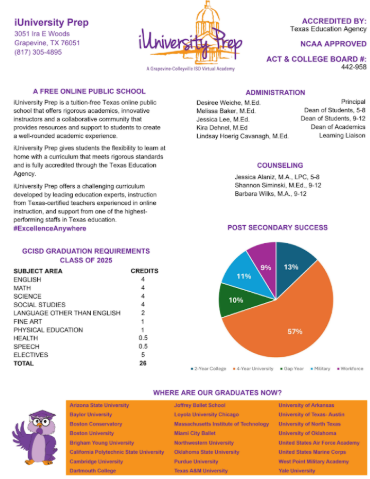
Graphic found on the IUP Virtual Vine GPA & Rank Page: https://sites.google.com/gcisd.net/virtual-vine-iuprep/student-resources/gpa-and-class-rank?authuser=0
Interview with former iUP student Matthew Lee:
Matthew Lee is a former iUP student who is now a sophomore at the University of North Texas. He is studying Business Computer Information Systems (BCIS) and has graciously agreed to answer a couple of questions for us. Here is what he had to say!
What is your college story? How did you end up in the position you are?
Matthew told us that attending iUniversity Prep helped him feel more prepared for the college transition. He said that iUniversity Prep is similar to college in many senses, one being that the responsibility for getting schoolwork done falls on your shoulders, something iUP already requires students to manage on their own. Matthew shared that UNT also uses Canvas as their main platform for schoolwork.
What job do you wish to have in 20 years?
Matthew hopes to advance in BCIS and eventually lead security technology in a position similar to his dad’s. His father is the chief information officer for the city of Lewisville. Getting to watch his dad at work and travel with him to conferences helped Matthew envision himself in a cybersecurity career.
What specifically about that job appeals to you?
“Watching my dad advance in his career and take on the IT world by storm was inspiring,“ Matthew said. He also expressed that he believes this career will remain important as AI continues to change certain careers. Along with that, Matthew believes the career will provide stability for his future family.
Why did you decide to pursue BCIS?
For Matthew, growing up watching his dad thrive in a technology career was inspiring to him. Matthew also found success in AP Computer Science A, where he earned a 5 on the AP exam.
Why did you decide to go to North Texas?
Matthew’s family has a history at UNT, and he found the university more reasonably priced than some of his other options. For Matthew, it was important to attend a college he respected without leaving him drowning in student loans. Having heard great stories from his father about UNT, he felt confident in committing there.
What would you say to students who are unsure about choosing the right major?
Matthew believes that college is your chance to explore and figure out what you want to do with the rest of your life. Especially going into your freshman year, you will not take many classes heavily tailored to your major, so pick what you believe is right for you. If you decide later that it isn’t the right fit, that’s okay too!
Any other thoughts to share?
Matthew encouraged us not to stress too much, but to take accountability and actually do the required work. “College isn’t as bad as they make it seem, “ Matthew said, adding that discipline is crucial to success.
Conclusion
As seniors going through this process, we have learned that you do not need to have your entire life mapped out yet. What matters is giving yourself options, asking important questions, and making the best decision you can with the information you have.
Whatever path you choose, take it seriously, stay disciplined, keep an open mind, and make it your own.